
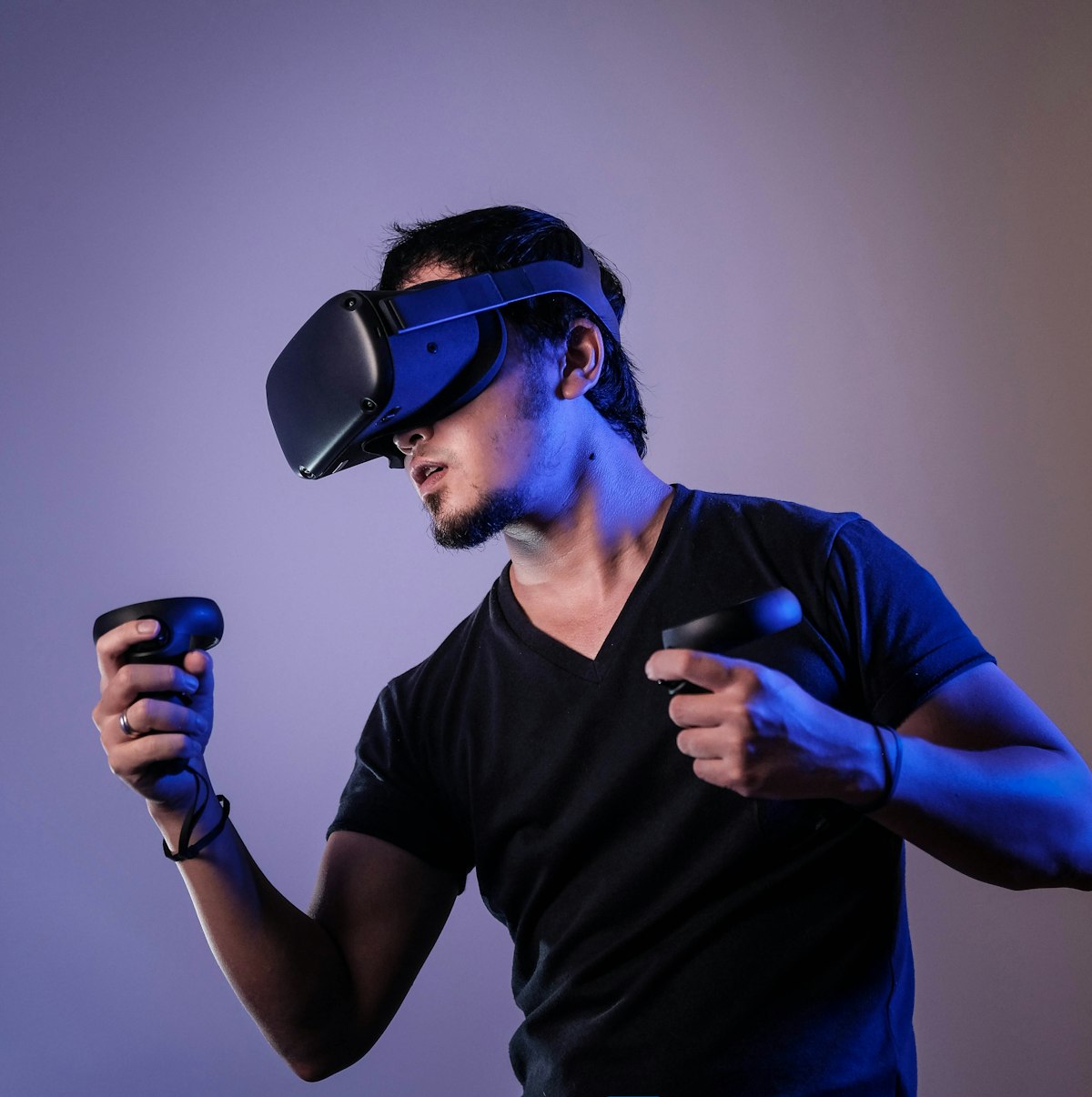
Spatial computing integrates persistent 3D environment mapping with real-time sensor fusion so that digital content can understand, respond to, and exist within the physical world.
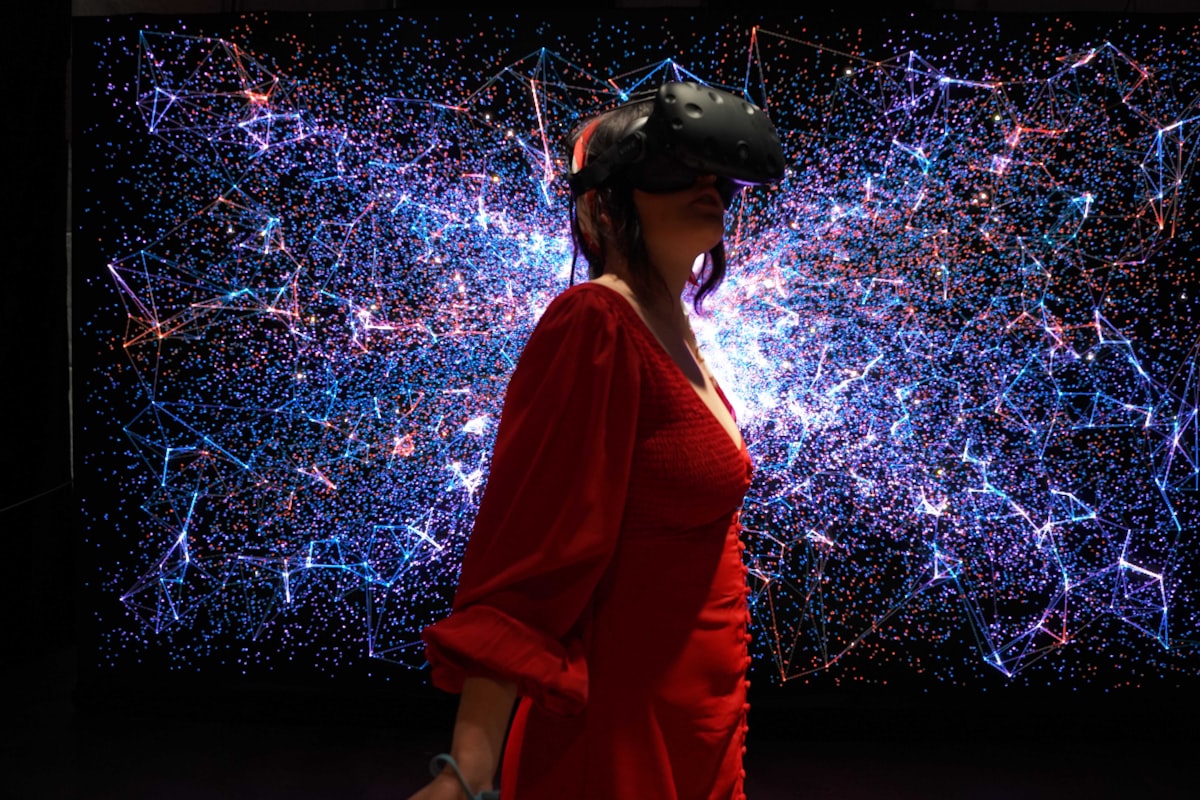
The concept was first formalised by MIT researcher Simon Greenwold in 2003, who described it as human interaction with a machine in which the machine retains and manipulates referents to real objects and spaces. Two decades later, devices like Apple Vision Pro and Meta Quest 3 materialise that vision: they map a room in seconds and anchor digital objects to specific physical locations.
What separates these systems from earlier immersive technology is persistence. A digital whiteboard pinned to your office wall stays in place when you leave and reappears when you return. A 3D prototype anchored to a conference table remains fixed even as colleagues walk around it. Our glossary entry on what spatial computing is breaks down the foundational terminology in more detail.
The global spatial computing market reached an estimated $182 billion in 2025, and is forecast to grow to approximately $221 billion in 2026. It’s expected to grow at a compound annual growth rate of around 20 percent through 2034, driven by enterprise adoption, consumer headset improvements, and the expanding AR-capable smartphone installed base.
Spatial computing counteracts these limitations by treating the physical environment itself as the interface. Mobile computing began the migration toward more natural input by introducing touch and motion sensors. Spatially-aware devices complete that migration: eye tracking replaces the mouse cursor, hand gestures replace the touchpad, and voice commands replace keyboard shortcuts. The physical space around the user becomes the canvas. Our guide to spatial UI design explores how interface design principles change when the flat screen disappears.
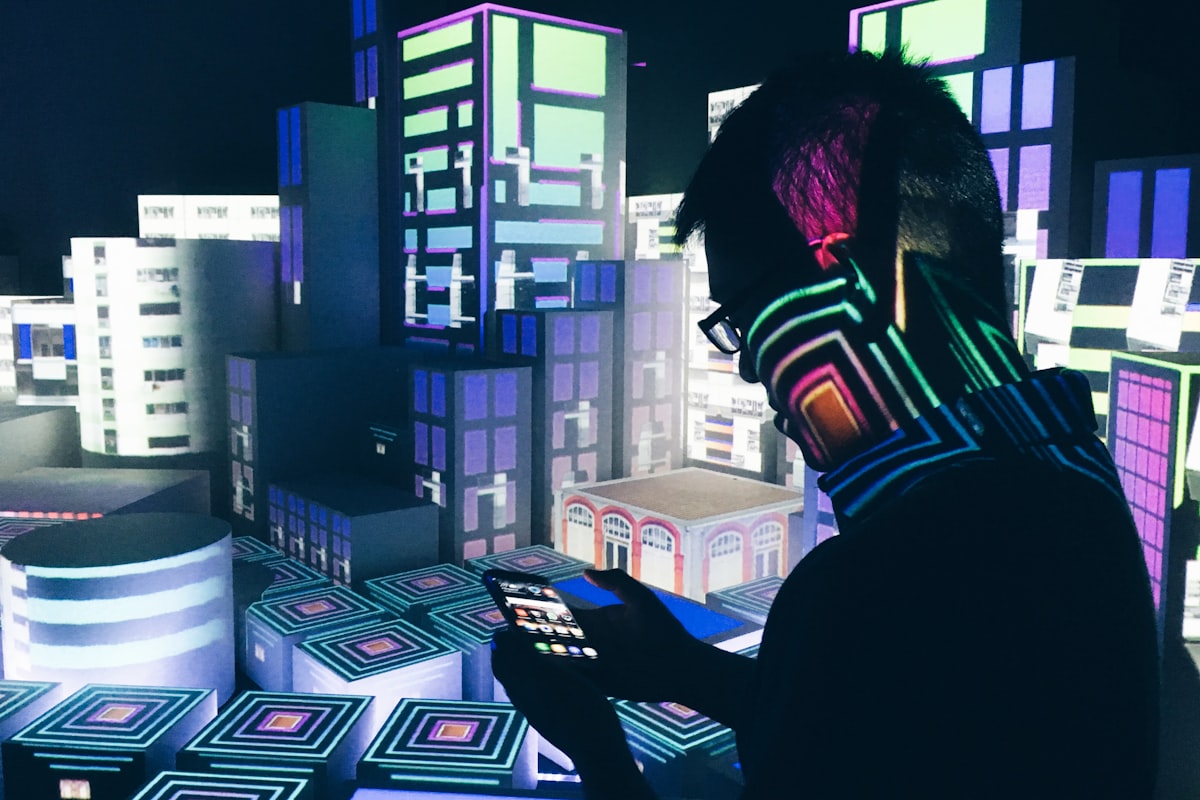
The foundational technology is Simultaneous Localisation and Mapping (SLAM), originally developed in robotics. SLAM answers two questions in real time: where is the device in physical space, and what does the surrounding environment look like? The system constructs a 3D map of the room while simultaneously tracking the device’s position within that map, updating the map and position estimate 60 to 120 times per second.
Modern spatial computing devices layer multiple sensor types. Depth cameras measure distance using structured light or time-of-flight, producing point clouds that define surfaces. RGB cameras capture visual features for tracking. Inertial measurement units (IMUs) record acceleration and rotation to fill gaps between camera frames. LiDAR, available on Apple’s Pro-tier devices, adds millimetre-accurate range data that improves surface reconstruction in low-light conditions.
Computer vision algorithms process these raw inputs into a unified scene understanding. Plane detection identifies floors, walls, tables, and other flat surfaces. Mesh generation creates 3D geometry that approximates complex shapes like furniture. Object recognition classifies items so that applications can respond contextually: a virtual ball can bounce off a real table because the system knows the table exists and where its surface is. Scene understanding continues to improve through machine learning models trained on millions of real-world environments.
Software transforms raw sensor data into compelling experiences. Apple’s RealityKit handles physically based rendering with automatic lighting estimation, shadow casting, and visual occlusion. Meta’s SDK provides hand and eye tracking APIs, scene understanding, and spatial anchors. Unity and Unreal Engine offer cross-platform abstraction layers that let a single codebase target multiple devices.
Interaction frameworks translate human gestures into application commands: pinch acts as click, swipe scrolls content, gaze guides selection. Each platform implements slightly different interaction models, which creates cross-platform development challenges that our team handles through platform-specific interaction layers.
Spatial interfaces rely on three primary input channels. Eye tracking determines where the user is looking with angular precision below one degree, enabling gaze-based selection and foveated rendering (reducing detail in peripheral vision to save processing power). Hand tracking captures finger positions and gestures without controllers, supporting direct manipulation of virtual objects. Voice input handles commands, dictation, and system control.
Combining these channels creates interaction depth unavailable on flat screens. A user looks at an object (eye tracking selects it), pinches to grab it (hand tracking confirms the action), and says “scale to 200 percent” (voice completes the command). Designing for this multi-modal input requires rethinking traditional UX assumptions. Our spatial UI design practice focuses specifically on these interaction patterns.
Apple’s visionOS represents the premium tier of spatial computing platforms. The operating system runs on custom silicon (M2 and R1 chips in Vision Pro) and provides a full window management system in 3D space. Applications can run as flat windows floating in the user’s environment, as volumetric objects that users walk around, or as fully immersive experiences that replace the real world entirely.
RealityKit serves as the rendering and simulation framework, handling physics, spatial audio, skeletal animation, and particle effects. ARKit provides the environmental understanding layer: room tracking, hand tracking, scene reconstruction, and image/object recognition. SwiftUI extensions let developers build spatial interfaces using familiar declarative syntax. Our review of the Story app for Vision Pro examines how spatial storytelling works on the platform and what developers can learn from its approach to immersive narrative. We also cover the latest Apple Vision Pro news and development updates for developers tracking the ecosystem’s evolution.
Meta Horizon OS powers the Quest 3 and Quest 3S headsets. Meta held approximately 72 percent of XR headset shipments in 2025, making it the dominant consumer platform. The operating system emphasises mixed reality through high-quality passthrough cameras. Developers targeting broad consumer reach typically start with Quest and expand to visionOS for premium experiences.
Both Unity and Unreal Engine provide cross-platform tooling that lets a single codebase target multiple devices. Unity dominates by project count, offering mature XR interaction frameworks and a large asset ecosystem. Unreal excels in visual fidelity, producing photorealistic environments valued in architectural visualisation and automotive design. The choice usually comes down to the project’s visual requirements, team expertise, and target platforms.
The W3C WebXR Device API standardises how browsers access immersive hardware, letting users click a link and enter a 3D experience without app installation. Performance constraints limit visual complexity compared to native applications, but WebXR excels for product configurators, virtual showrooms, educational simulations, and any scenario where frictionless access matters more than graphical fidelity. OpenXR, maintained by the Khronos Group, provides a hardware abstraction layer at the native level, reducing the effort needed to support new headsets and display terminals.
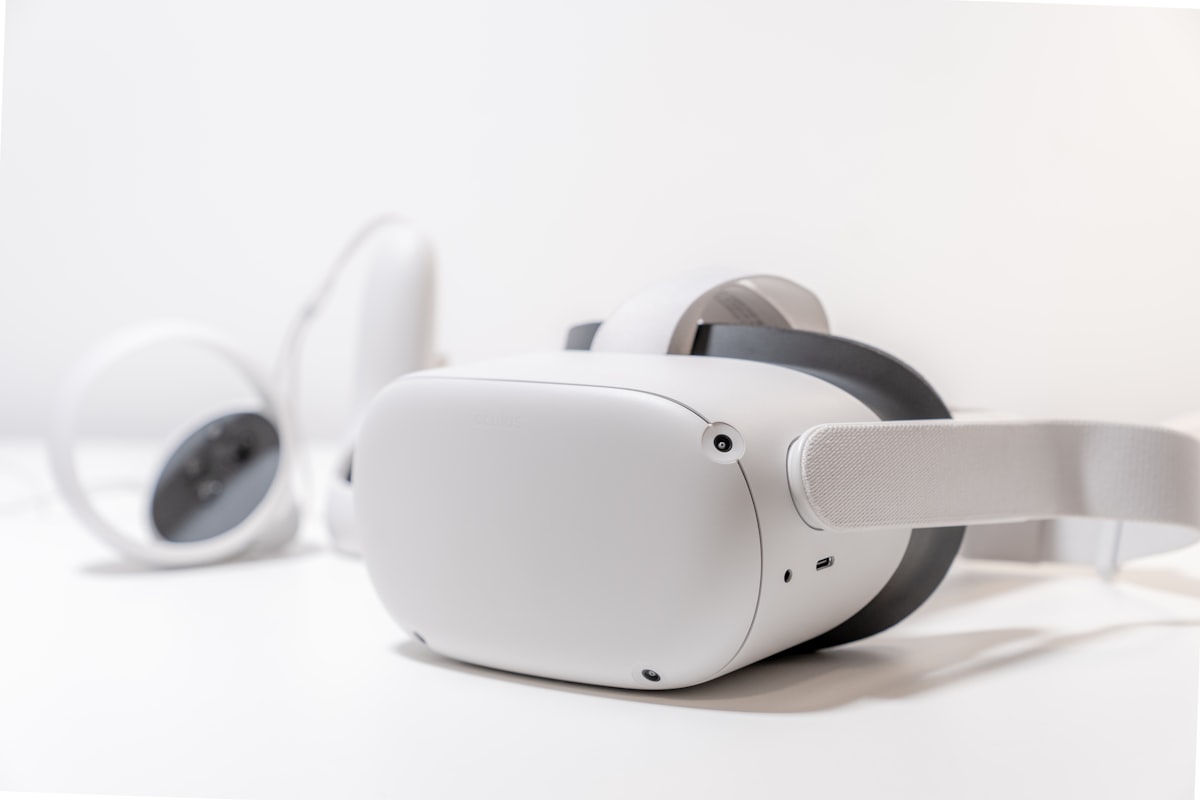
Enterprise adoption is the fastest-growing segment. Remote assistance connects field technicians with experts who annotate the technician’s real-world view in 3D. Digital twins create virtual replicas of physical assets for monitoring, simulation, and predictive maintenance. XR apps and services spending is projected to reach roughly $12 billion in 2025, with enterprise representing the majority of platform demand. Our computer vision development services page outlines how we build the perception systems underpinning these enterprise solutions.
Immersive training is another high-value application. Organisations deploy 3D simulation environments for scenarios that are dangerous, expensive, or impossible to replicate physically: emergency response, heavy equipment operation, surgical procedures, and military exercises. VR-trained employees were up to 275 percent more confident to act on what they learned, and at 3,000 learners, VR training became 52 percent more cost-effective than classroom delivery.
Surgeons visualise CT and MRI data as detailed 3D reconstructions overlaid on the patient during procedures. Orthopedic surgeons plan implant placement by viewing bone geometry at true scale. Neurosurgeons trace neural pathways through holographic brain models before making incisions. Medical students learn anatomy by examining life-size 3D organs they can rotate, peel apart layer by layer, and observe in real time. Therapeutic applications include pain management through immersive distraction, physical rehabilitation with gamified exercises, and exposure therapy for phobias and PTSD.
In education, students manipulate molecular structures, walk through historical reconstructions, and conduct virtual lab experiments. Retail applications let customers place furniture in their living rooms before buying (IKEA Place remains the most-cited example) or try on clothing and eyewear virtually. Architects and interior designers walk clients through full-scale building models before construction begins, catching design issues that 2D drawings miss. Entertainment spans gaming (the largest current consumer market), live events with AR overlays, location-based experiences, and immersive storytelling that blurs the line between audience and narrative.
Building immersive applications follows a structured workflow. Concept development starts with spatial prototyping: sketching interactions in 3D, often using tools like ShapesXR or Unity’s XR Interaction Toolkit. Prototyping moves quickly to headset builds, because interaction patterns feel fundamentally different in a headset compared to a flat monitor preview. The build phase covers 3D asset creation, rendering optimisation, interaction programming, and platform integration. Deployment includes device provisioning, performance profiling, and iterative user testing in representative physical environments.
Asset pipelines require particular attention. 3D models must be optimised for real-time rendering with strict polygon budgets that vary by platform. Texture atlasing, mesh decimation, and material instancing reduce draw calls and memory consumption. Audio demands spatial processing so that sounds originate from the correct position in 3D space, requiring HRTF (head-related transfer function) profiles and distance-based attenuation curves. These technical constraints shape every creative decision from the earliest design stage.
Interaction design is the biggest hurdle for spatial computing projects. Traditional UI patterns do not translate cleanly into 3D: dropdown menus are confusing when floating in mid-air, scroll bars have no meaning without a flat surface. Effective teams design spatially-native interactions from scratch rather than adapting 2D conventions, and user-test on real hardware from the earliest possible stage.
Performance optimisation presents ongoing challenges. Spatial applications must maintain 90 frames per second (or higher on Vision Pro at 96Hz) to avoid motion sickness. This frame budget leaves roughly 11 milliseconds per frame for all rendering, physics, and application logic. Techniques include level-of-detail systems, occlusion culling, dynamic resolution scaling, and foveated rendering (reducing detail in peripheral vision based on eye tracking, a standard approach on Vision Pro).
Cross-platform development adds complexity. Testing across devices adds complexity; an app targeting both visionOS and Quest 3 must handle dramatically different processing power, display characteristics, and interaction paradigms. Automated testing pipelines that deploy builds to multiple devices simultaneously save significant time, and performance profiling tools specific to each platform help identify bottlenecks that generic profilers miss. Environment profiling is equally important: testing in representative physical spaces with varied lighting, surface types, and room geometries catches issues that lab environments conceal.
Apple’s Vision Pro occupies the premium tier with the highest visual fidelity and most sophisticated eye and hand tracking. Meta dominates consumer adoption with the Quest line’s approximately 72 percent market share. Microsoft serves enterprise clients with HoloLens, focusing on defence and industrial applications. Magic Leap has pivoted to enterprise, providing specialised hardware for surgical suites, factory floors, and design studios. Each company controls a vertical stack: hardware, operating system, SDK, and content distribution.
Unity Technologies and Epic Games provide the cross-platform engines used by the majority of immersive application developers. Khronos Group advances the OpenXR standard to reduce fragmentation. Niantic, Snap, and other mobile platform companies bring AR capabilities to smartphones, expanding the addressable market beyond dedicated headsets. Startups focused on specific verticals, such as Surgical Theater for neurosurgery visualisation and Matterport for spatial capture, continue to attract significant investment.
Development studios range from large agencies handling Fortune 500 enterprise deployments to specialised boutiques focused on specific platforms or industries. A studio specialising in building applications for immersive platforms. Unlike general software agencies, these studios maintain dedicated expertise in 3D interaction design, real-time rendering, SLAM integration, and platform-specific development across visionOS, Quest, and WebXR. BOA XR handles the full lifecycle: concept, prototyping, production development, device testing, and deployment support.
Hardware is trending toward lighter form factors, improved displays, and lower prices. Micro-LED advances will enable brighter, more efficient panels. Battery improvements will push sessions beyond the current two-to-three-hour window. The trajectory points toward everyday AR glasses resembling conventional eyewear by 2028 to 2030. Global XR device shipments grew 41.6 percent in 2025, reaching 14.5 million units, with further growth of 33.5 percent forecast for 2026.
Artificial intelligence and spatial computing platforms are converging rapidly. Large language models with spatial understanding can interpret 3D scenes, answer questions about physical environments, and generate content from natural language prompts. Computer vision models trained on depth data identify objects, predict user intent, and automate environment adaptation. In 2026, AI-assisted development tools are already reducing build times by automating asset creation, interaction design, and performance profiling. Our guide to ArK augmented reality explains how Microsoft’s knowledge-interactive AR system combines AI with spatial awareness.
Enterprise momentum is accelerating. Organisations that ran pilot programmes in 2023 and 2024 are expanding to production-scale rollouts. Key drivers include training cost reduction (with VR training delivering 52 percent savings at scale compared to classroom delivery), remote collaboration improvements, and digital twin deployment across manufacturing, energy, and logistics. The extended reality market is projected to grow at 26.5 percent CAGR through 2030, with smart glasses expected to surpass VR and MR headsets in unit shipments as the form factor matures.
It lets digital content understand and interact with the physical world around you. Instead of looking at a flat screen, you place windows, 3D models, and interactive tools in the actual space of your room or office. The content stays anchored in place, responds to hand gestures and eye movements, and understands surfaces like tables and walls.
Virtual reality creates a completely immersive digital environment that replaces what you see. Spatially-aware systems work differently by blending digital content with your real surroundings. You still see your room, colleagues, and coffee cup, but now digital screens and 3D objects coexist with them. VR is one mode these platforms can deliver, but the broader technology encompasses much more.
Apple leads premium hardware with Vision Pro and visionOS. Meta leads consumer adoption with the Quest headset line. Microsoft serves enterprise clients with HoloLens. On the software side, Unity and Unreal Engine dominate application development. Studios like BOA XR build production applications across all of these platforms.
BOA XR is a development studio specialising in building applications for immersive platforms. We handle projects from initial concept through prototyping, production development, device testing, and deployment. Our team works across visionOS, Quest, and WebXR, with dedicated expertise in 3D interaction design, real-time rendering, and SLAM integration.
Ready to bring immersive technology to your organisation? Schedule a free consultation today. We will discuss your objectives, evaluate platform options, and outline a development approach tailored to your requirements.
The spatial computing industry ships hardware fast. We make sure the software keeps up.